Most businesses assume the problem with their emails is the writing. Maybe the subject line isn’t punchy enough, or the offer isn’t good enough. But data tells us that the average email list decays by about 22.5% each year.
So, before you obsess over open rates or endlessly tweak your call-to-action, ask yourself: do these addresses connect you with someone, or are you just firing emails into a database that leads nowhere? Email verification is the answer to that question.
Whether you’re striving to grow an online shop or rallying donors for a cause that keeps you up at night, email verification ensures your message lands in front of real humans who care about what you have to say.
What Is Email Verification?
Email verification is the process of checking whether an email address is real and capable of receiving messages.
An email address looking right and being right are two very different things. “joseph@gmial.com”, for instance, looks fine at a glance. It’ll sail right through a basic signup form. But it’ll never reach Joseph. There is no Joseph there, but rather a typo living in your database and wrecking your deliverability.
Email verification catches that. It weeds out the addresses that are malformed, the domains that don’t exist, the inboxes that were abandoned three years ago, and the ones that were fake from the very start (the throwaway addresses people use when they want your discount code but not your newsletter).
What you’re left with after verification is a list built for engagement. Not a bigger list, but a better one. And in email marketing, that distinction is everything.
How Email Verification Works
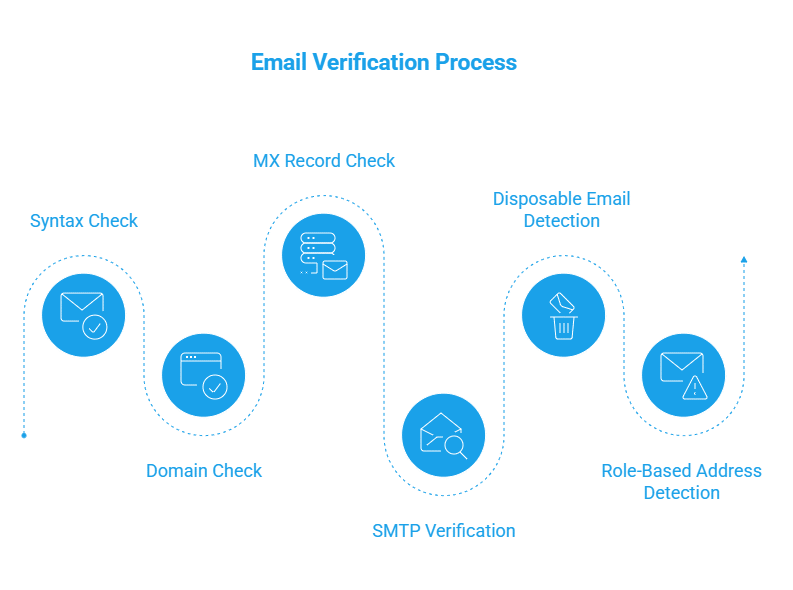
Instead of blindly trusting every address on your list, verification puts each one through a series of checks to determine whether there’s an actual person on the other end. By the time an address clears all the checkpoints, you know it’s the real deal. Here’s how the process works.
- Syntax Check. This is where the system checks whether the address is structured like an email address. Does it have an “@”? A domain? Or any rogue spaces or illegal characters? It sounds basic, but you’d be surprised how many addresses trip over this first hurdle because someone typed “name@” and hit submit without a second thought.
- Domain Check. Once the structure looks good, verification turns its attention to the domain (the part after the “@”). Does “gmial.com” actually exist? Does “randomjunkdomain.net” have any real presence on the internet? If the domain is a ghost, so is the email. This step makes sure you’re not sending messages to a neighborhood that was never built.
- MX Record Check. MX stands for Mail Exchange. These are the records that tell the internet where to deliver emails for a given domain. If a domain has no MX records, it literally cannot receive mail, regardless of how legitimate it looks.
- SMTP Verification. The system knocks on the door of the recipient’s mail server and asks, “Hey, does this inbox exist?” — without ever actually sending an email. The server responds, the verification tool listens, and you get a yes or no. It’s the closest thing to certainty you can get without pressing send yourself.
- Disposable Email Detection. Some people sign up with a real address. Others grab a 10-minute throwaway from Mailinator or Temp Mail, claim whatever freebie you’re offering, and vanish forever. Disposable email detection knows the usual suspects (the domains that exist purely to generate temporary inboxes) and flags them before they clog up your list with dead weight.
- Role-Based Address Detection. This catches the “info@,” “support@,” or “admin@” addresses. While these are technically valid, they usually go to a group inbox rather than a specific human being, so your chances of getting ignored or being marked as spam get really high.
Why Email Verification Matters
You could have the most compelling offer and the most perfectly timed send and still not succeed. It’s not because your marketing is bad, but because the foundation underneath is. Email verification is the foundation. Here’s what it’s protecting you from.
- Protects sender reputation and deliverability. 83% of non-delivery stems from poor sender reputation. Your sender reputation is like a credit score for your email. It’s always being calculated and absolutely determines what happens to your messages. ISPs watch how your emails perform, and if too many of them are bouncing or getting flagged, they start treating you like the problem. Verification keeps your reputation healthy, which keeps your emails landing in inboxes and not spam folders.
- Keeps the costs down. Most email platforms charge by the number of contacts or emails sent. This means you’re paying for every fake address and abandoned inbox. Email verification ensures your hard-earned dollars are only spent on people who want to hear from your nonprofit or brand.
- Prevents fake signups. Whether it’s a bot trying to skew your election poll or someone using a burner email to game your first-purchase discount, fake signups can be a massive headache. Verification makes sure that every new person entering your world intends to stick around.
- Improves marketing ROI. When you scrub the junk, everything downstream gets better. Your open rates climb because you’re reaching real and engaged people. Your click-through rates start to reflect actual interest. Best of all, your campaign data tells you the truth instead of a distorted picture compromised by invalid or inactive addresses. Every dollar you spend on email goes further, not because you sent more, but because you sent smarter.
Common Use Cases of Email Verification

From the moment someone signs up to the campaigns designed to bring them back, email verification shapes the quality of your communication at every stage.
Signup and Registration Form Validation
As soon as someone types their email into your signup form, it’s your one clean shot at collecting accurate information. If you let a typo or a fake address through here, you’re nursing that problem for as long as that contact sits in your list.
Real-time verification at the point of signup catches errors while the person is still right there, still able to correct “gnail.com” to “gmail.com” before they hit submit and wonder why they never heard from you.
Order Confirmations
When a customer buys something from you, they’re naturally expecting a confirmation or a shipping update. If their email address is wrong, even slightly, that communication can disappear.
As a result, they’re left wondering what happened to their order, which quickly turns into a frustrated customer and a refund conversation nobody wanted to have. Verification at checkout is how you make sure the post-purchase experience reaches the person who purchased.
Donor and Supporter Outreach
For nonprofits and fundraising organizations, your email list is a community. These are people who believe in what you’re doing. They’ve given their time, their money, or their voice to your cause, and reaching them reliably matters.
Whether you’re announcing a campaign milestone or making an urgent appeal, a clean list makes sure those messages land. After all, a donor who never hears back from you doesn’t stay a donor for long.
Email Campaign Optimization
Before you hit send on any campaign — think a seasonal promotion, a product launch, a fundraising push — your list deserves a health check. Sending to a bloated, unverified list actively skews your data and wastes your money.
Your open rates look lower than they are, and your engagement metrics lie to you. As such, you end up making decisions based on a distorted picture. Verification before a campaign send means the numbers you see after are numbers you can trust and build on.
Re-Engagement and Win-Back Campaigns
Going back to dormant subscribers is already a delicate game because you’re essentially knocking on the door of someone who’s been ignoring you, hoping they’ll answer.
The last thing you need is to knock on doors that no longer exist. Lists go stale fast because people change jobs, abandon old inboxes, and move on.
Running verification before a win-back campaign means you’re spending that effort (and that goodwill) on addresses that are still live.
Verify Smarter With The Data Group
Your email list is only as powerful as it is accurate. When you clean your list, you clear the path for genuine engagement and a sender reputation that stays green.
At The Data Group, we don’t just verify but enrich. Our batch and real-time email verification services check every address against industry-leading standards, so the emails you send arrive where they’re supposed to.
Got incomplete records? Missing email addresses for contacts you already know? We append what’s missing and hand you back a list that’s ready to do real work, starting at just $0.001 per record.
Your list is sitting on untapped revenue. Let’s go get it. Get started with The Data Group today!