An old memory could be a risky way to understand someone, or start a conversation, for that matter. You may, for instance, ask someone how their Great Dane is doing, only to find out the dog passed away in 2024, and they’ve since moved to a different coast and pivoted to professional pickleball. Unfortunately, in consumer marketing, we do this to our audience every single day. We send “We miss you!” emails to addresses that haven’t been logged into since the pandemic, or promote location-specific offers to consumers who have already relocated.
We like to think we’re being personal, but without the full story, we’re working on assumptions. For example, according to Deloitte, 92% of retailers believe they offer personalized experiences, but only 48% of customers agree.
This is where data append becomes relevant. It lets you build a more complete view of the person behind the screen, rather than working with an incomplete customer profile that contains an outdated email address or personal info. That way, you can better target your customers to meet their expectations.
What Is Data Append?
Data appending is the process of integrating missing identifiers into your existing customer records. Put simply, it’s about moving past the entry-level information you likely gathered during a quick sign-up (like a single email address) and layering in the specific demographic, geographic, or behavioral details needed to understand who you’re talking to.
Note that data append only works well when the foundation is solid. That’s why it’s closely tied to data cleansing, which is the process of fixing your existing database before anything is added. Of course, if you try to add new insights to a database full of typos and duplicates, you’re merely scaling your mistakes.
Data cleansing removes duplicates, corrects errors, standardizes formats, and filters out outdated or invalid records. In other words, cleansing makes sure you’re not building on messy or broken data. When done correctly as a single, fluid motion, you’re left with a database that isn’t just larger, but fundamentally more accurate.
Common Types of Data Append Services
Missing data isn’t one single thing; it shows up in different forms depending on how incomplete your customer records are.
In consumer databases, you’re rarely dealing with a uniform gap. One record might be missing an email, another might lack a valid phone number, while another has no clue about demographics or buying behavior. That’s why data append services are split into different types, and each is designed to fill a specific kind of gap.
- Email Append: It helps you find email addresses for people already in your database by matching their names and addresses. This lets you reach them through email instead of relying only on direct mail, which can lower your acquisition costs.
- Phone Append: A verified mobile number is gold when it comes to SMS marketing. Forbes highlights that SMS has an open rate as high as 98%. This service identifies whether a number is a landline or a cell and appends the most recent, active digits to your file. That way, your outreach hits a pocket instead of a void.
- Address Append: Customers move, but they don’t always tell you. Address append uses change-of-address data to keep their current location up to date, so your mail and local offers reach them where they actually live.
- Demographic Append adds key details like age, household income, marital status, and education level. This helps you move beyond a generic “Dear Customer” message and know you’re speaking to a high-earning millennial who probably cares about sustainability.
How Data Append Works (Step-by-Step)
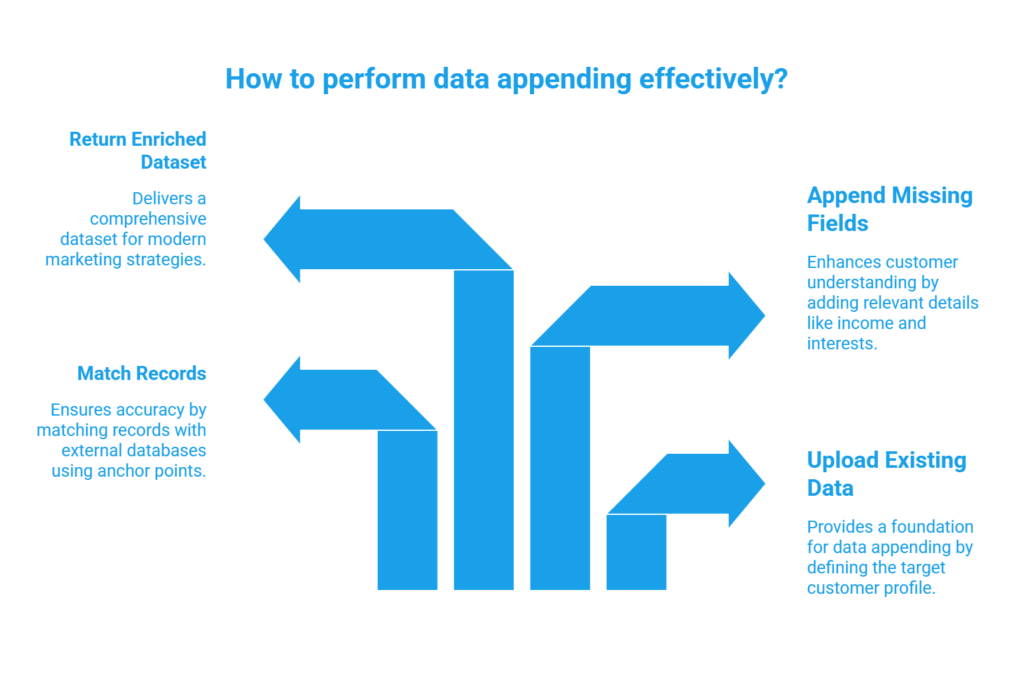
Adding data is easy. Adding correct data that matches the right person is where the real value (and risk control) sits. Here’s how data appending works.
Uploading Existing Customer Data
Everything starts with you exporting your current seed list (even if it’s just names and zip codes) and securely transferring it to the service provider.
This is where you define exactly what you’re looking for. Instead of a blind dump, you’re providing the foundation that the provider will use to hunt for the missing pieces.
Match Records With External Databases
The provider takes your file and runs it against massive, multi-sourced master repositories. Using sophisticated matching logic, they look for anchor points, like a unique email or an old phone number, to find the exact match within billions of verified records. The goal is to confirm it’s the same person.
Append Missing Fields
Once they confirm a match, the provider merges the new data into your file. If you started with just a name and email, you may now have additional details like household income, interests, or a current address.
This is the phase where your incomplete file starts to gain the depth needed for real segmentation.
Return Enriched Dataset
After a final quality check to ensure the new data is formatted correctly and ready for your specific marketing database, the provider sends the file back to you.
You’re no longer working with the same list you sent over; you now have a comprehensive dataset that allows you to talk to your customers based on who they are today, not who they were when they first signed up.
Data Append vs Data Enrichment: What’s the Difference?
Data append takes your existing records and adds missing fields from external sources, like emails, phone numbers, addresses, or basic demographic details.
Data enrichment, on the other hand, is broader. It enhances what you already have by layering in a deeper context. That could mean behavioral insights, intent signals, purchase patterns, or third-party attributes. The goal is to help you understand why a customer behaves a certain way (not just who they are).
In simple terms, append completes your data, while enrichment makes it smarter.
Naturally, the former is your first step. You can’t enrich a profile if you don’t even have a valid way to contact them. You append the contact info first to establish the connection, and then you enrich that profile to make the conversation worth their time. One builds the bridge; the other decides what you’re going to say once you cross it.
Real-World Use Cases of Data Append
Data append fills gaps in your data so your campaigns don’t feel half-built, whether it’s missing contact details or records that just aren’t usable yet. Let’s see how it works in real marketing situations and where it tends to make the biggest difference.
Re-Engaging Inactive Customers
Perhaps you have customers who haven’t opened an email since 2023 or haven’t logged into their account in eighteen months. You can use the data you have (like an old shipping address or a last name and zip code) to find their current, active email or even a mobile number.
If you append recent purchase behavior and realize that a customer who used to buy baby clothes from you is now browsing for back-to-school gear elsewhere, you can pivot your strategy.
You stop sending them diaper coupons and send them lunchbox deals instead. That way, you’re showing up with a relevant reason for them to come back.
Loyalty and Retention Campaigns
Loyalty isn’t a static thing. A customer who was loyal two years ago might be a completely different person today. If you’re still trying to retain them using the profile they created when they first signed up, you’re talking to a stranger.
Data appending allows you to evolve with them. By layering in updated demographic and lifestyle data, you can spot the life stages that trigger a change in brand loyalty. If a long-term customer suddenly moves from an apartment to a house, or their household income jumps, their needs change.
And if you don’t append that info, you’ll keep sending them the “budget-friendly” offers that no longer resonate.
It also helps you identify your true VIPs. You might have a customer who only spends $50 a year with you, so you ignore them in your retention tiers.
But if you append behavioral data and realize they spend $5,000 a year with a competitor in your exact niche, you’ve just identified a massive share-of-wallet opportunity. You can then pivot your retention campaign to win that loyalty back before they’re gone for good.
Ecommerce and Retail Targeting
Data appending allows you to step outside your own storefront and see the bigger picture. For instance, if you’re a home goods retailer and you append intent data, you might discover that a segment of your browsers just applied for a mortgage or started a major renovation project.
Suddenly, that generic 10% discount code feels pretty weak. You can now hit them with a curated New Home bundle. You’re moving from reactive selling to proactive problem-solving.
It also solves the shipping address blind spot. Many retail brands have thousands of customers who only ever buy gifts for others. Without appending, your system thinks that a 60-year-old grandfather is a fan of toddler toys.
With demographic data, you can separate the buyer from the end-user. You can then target that buyer with “Grandparent-specific” messaging while also reaching out to the actual household with products they’ll keep for themselves.
Nonprofit Donor Reactivation
Data append lets you find that donor who moved two towns over and never updated their records. More importantly, you might discover that a small-dollar donor from 2021 has since seen a significant jump in household income or has started donating to similar causes at a much higher level.
So, you no longer need to send them a generic “please donate” postcard. Instead, you can reach out with a personalized reactivation campaign that acknowledges their history while also reflecting their current capacity to give.
How to Choose a Data Append Provider

Choosing a data append service provider directly shapes how usable your marketing data will be. Consider these factors to separate a reliable provider from a risky one.
- Data Quality. Ask them where they get their information from. Reliable providers match your data against high-confidence sources. If they can’t explain the source, the data is likely a guess.
- Match Rate Expectations. For a consumer marketer in 2026, a 90% match rate is the gold standard you should be aiming for if you’re working with a high-tier provider. While a decent run might land you in the 60% range, hitting that 90% mark means your provider has a massive, multi-sourced data network.
- Compliance Standards. Your provider must demonstrate full alignment with the CCPA to ensure proper data sourcing. They also need to strictly follow CAN-SPAM rules during email enrichment and the TCPA (Telephone Consumer Protection Act) guidelines for phone and SMS appends. If they can’t provide a clear chain of custody for how consent was captured for the data they’re selling you, you’re the one who inherits the legal risk.
- Pricing Model. Look for providers that offer rollover credits or a pay-as-you-go model. In 2026, the standard rate for a high-quality consumer append is roughly $0.02 to $0.05 per match. If you’re paying significantly less, you’re likely getting stale, bulk-scraped data. If you’re paying more, you’re probably paying for a brand name, not better accuracy.
Make Every Record Count With The Data Group
When your customer data is incomplete, everything built on top of it, from segmentation to personalization, becomes unstable. But when that same data is cleaned, appended, and properly structured, it can drive real business growth.
If you’re ready to see what that looks like in practice, The Data Group can help. Our team helps consumer marketers enrich their datasets with up to 90% match rates at just $0.02 per match.
Whether you’re trying to recover missing contacts or scale campaigns more efficiently, we make your existing data significantly more valuable without inflating your acquisition costs.
Book your free trial with The Data Group today and see exactly what’s missing from your database!
FAQs
What does data append mean?
It simply means adding missing information to your existing customer data, such as filling in gaps in emails, phone numbers, addresses, or other details, so your records become more complete.
What types of data can be appended?
Common ones include emails, phone numbers, physical addresses, demographic details (like age or income range), and sometimes even behavioral or interest-based data, depending on the provider.
Is the data append accurate?
Accuracy depends on the quality of the provider and the freshness of the data, but when done properly, it’s highly reliable. At The Data Group, for example, append processes are built around verified, regularly updated datasets and strict matching logic, which typically delivers match rates of up to 90% depending on the quality of the original file.
When should marketers use data append?
Use it when your database is incomplete but still valuable, like when you have existing customers, but not enough detail to properly segment or run targeted campaigns.