Perhaps you’ve run a campaign where the copy was sharp, the design was gorgeous, and you were convinced it was going to break your conversion records. But all you got in return were bounced emails and disconnected landlines.
That’s essentially what happens when your marketing strategy meets dirty data. It’s a massive problem too, costing organizations around $12.9 million annually.
Data hygiene fixes the issue by keeping your customer information clean and accurate, so you can trust what you’re working with. After all, marketing is only as good as its delivery system, and for many organizations, the system is struggling. Let’s make sure you’re not one of them.
What Is Data Hygiene?
Data hygiene is an ongoing process of keeping your data clean, accurate, consistent, and up to date so it remains reliable for decision-making.
Research tells us that around 22.5% of data decays annually. People tend to switch emails, move cities, update preferences, and abandon old accounts. The latest census highlights that in 2024, around 25.87 million US citizens moved, and 30 million planned to move in the upcoming months. So, even a solid database can go out of date faster than you expect.
Data hygiene finds duplicates in your records, fixes typos, and, most importantly, removes inactive records that are inflating your subscription costs.
Consider this:
- Data quality tells you how good your info is right now
- Data hygiene is the habit of keeping it that way
When done right, you’re ensuring that when you hit send on a personalized offer for a high-value customer, it reaches them and not their old work email from three jobs ago. You’re making sure that “Michael Smith” doesn’t receive the same catalog twice because he’s in your system once as M. Smith and once as Michael Smith.
Data Hygiene vs Data Cleansing
Data cleansing is a corrective action. It’s what you do when your data is already messy. You hire a service or run a script to remove duplicate entries, fix formatting, and fill gaps. It’s often periodic and usually triggered by a problem.
Data hygiene, on the other hand, is preventive. It’s an ongoing practice of keeping your data clean, so it doesn’t degrade again. Instead of waiting for issues to build up, you set a system that stops them at the source.
Here’s a quick breakdown.
Feature | Data Cleansing | Data Hygiene |
Frequency | Reactive (once a quarter or every 6 months) | Proactive (real-time or weekly) |
Goal | Fix the damage that’s already been done | Prevent the damage from occurring |
Action | Deduplicating, formatting, and purging | Validation at entry, standardizing fields |
Mindset | “We’re in trouble, clean the list.” | “This is just how we handle our data.” |
Why Data Quality Matters In B2C

When you start with a single incorrect data point, say, a misspelled last name or an outdated physical address, it doesn’t sit there but ripples.
It affects your segmentation, which ruins your personalization, which tanks your deliverability, and eventually gets your domain blacklisted. This means you’re losing the Lifetime Value (LTV) of that customer and the integrity of your entire marketing stack.
Let’s look at a small mistake to understand how it plays out in the real world.
- The Trigger: A customer, “Michael,” signs up for your loyalty program but types his email as micheal@gnail.com.
- Friction: Your automated Welcome discount (with a 20% margin) bounces. Michael thinks you’re a flake and buys from a competitor instead.
- The Waste: Because your system doesn’t flag the bad email, you spend the next six months serving retargeting ads to a “potential customer” that doesn’t exist. You’ve now spent $50 in ad impressions on no one.
- The Reputation Hit: Michael eventually gets frustrated and marks your brand as “unreliable” in his mind. Meanwhile, your ESP (Email Service Provider) sees your bounce rates climbing and starts pushing your good emails into everyone else’s spam folders.
By the time you realize what’s happening, that one typo hasn’t just cost you a $100 sale; it’s corrupted your analytics and damaged your ability to reach 10,000 other Michaels.
How Data Hygiene Helps
Even the brightest ideas can fail if they’re built on bad data. Data hygiene keeps your marketing running on reliable inputs, making customer acquisition and retention more efficient.
- Better Personalization. True B2C personalization is about sending a “We missed you” discount for cat food to a cat owner, not someone who bought a birdhouse three years ago. Good hygiene ensures your tags and triggers are actually working correctly on accurate behavioral data.
- Improved Customer Experience. Nothing kills a brand’s reputation faster than incompetence. For a donor, receiving three separate “First-time Giver” letters in the mail because their name is in your system as Rob, Robert, and Bob makes your organization look disorganized. It signals that you don’t actually know who they are. Cleaning your data is an act of respect. It shows the customer you’re paying attention.
- Higher Campaign Performance. Marketing is a game of margins. If you’re a retailer, a 2% lift in email open rates can mean thousands of dollars in extra weekend revenue. Data hygiene directly boosts these metrics by removing bounces and inactive accounts. You’ll see your open, click-through, and conversion rates climb simply because you’re finally talking to a room full of real, reachable people.
- Reduced Waste Spend. Every time you send a high-gloss catalog to a physical address that hasn’t existed since 2018, or pay to serve a retargeting ad to a bot, you’re wasting your money. When you commit to data hygiene, you’re essentially fixing those leaks by focusing every cent on real, reachable human beings. It’s the closest thing to an instant budget increase; you aren’t actually spending more, you’re just making sure your money is finally working for you.
Data Hygiene Best Practices
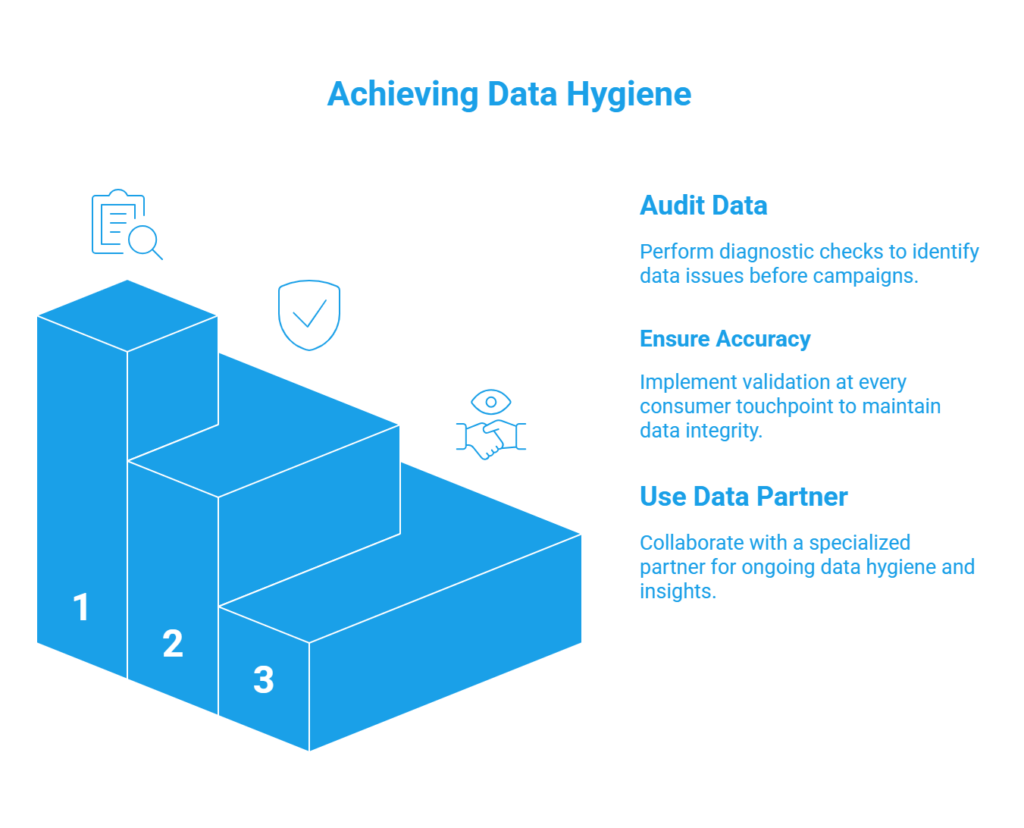
Things move at the speed of a single “Buy Now” click in the B2C world. As such, you need a proactive approach to keep your data from decaying. Here’s how to do that.
Audit Your Data Before It Impacts Campaigns
The worst time to realize your data is dirty is halfway through a $50,000 seasonal campaign. Before you commit your budget, you need to perform a diagnostic check. Look for the red flags: Are your bounce rates creeping up? Is your abandoned cart automation triggering for people who haven’t visited the site in a year?
An audit reveals exactly where the leaks are, whether it’s a specific lead source that’s feeding you junk or an old segment that has gone completely cold. By auditing before you hit send, you ensure you aren’t just paying for nothing.
Ensure Accuracy Across Every Consumer Touchpoint
Data enters your ecosystem from everywhere: point-of-sale systems, social media, newsletter signups, and even customer service calls. If these touchpoints are disconnected, you end up with fragmented customers.
The goal is a unified standard. Every entry point should have basic validation in place. If a user enters a phone number that’s missing a digit or an address that doesn’t match USPS records, your system should catch it in real-time.
Accuracy at the source is the only way to prevent a massive clean-up headache six months down the road.
Use a Dedicated Data Partner for Ongoing Hygiene
As a marketer, trying to manually scrub 100,000 records in Excel can lead to burnout and human error. To truly scale, you need a partner that specializes in maintaining data health.
Working with a dedicated partner like The Data Group changes the game. Our data append and hygiene services take your customer profile and cross-check it against massive, verified datasets to fill in the gaps.
Whether it’s appending a missing phone number to reach a donor or validating a physical address for a retail catalog, we take your obsolete data and convert it into actionable insights.
This moves you away from the one-time scrub model and into a state of continuous hygiene. The goal is to make sure that your source of truth stays true every single day.
Maintain Data Accuracy With The Data Group’s Data Hygiene Services
You’ve done the hard work of building your audience; now let’s make sure you can actually reach them. Whether you’re a retailer looking to boost sales or a nonprofit trying to reconnect with lapsed donors, The Data Group is your secret for keeping your database in good shape.
Our industry-leading append services offer a 90% match rate on your records and an exceptional value of $0.02 per match.
Stop letting bad data hold you back! Get a free trial today and see how better data can improve your marketing results.
FAQs
What is a data hygiene process?
It’s the set of ongoing steps used to keep data clean and reliable. It may, for example, remove duplicates, fix errors, update old records, and ensure new data is entered correctly from the start.
What is the difference between data quality and data hygiene?
Data quality is the result — how accurate and usable your data is right now. Data hygiene is the process that keeps it that way over time.
Why is data hygiene important?
Because bad data leads to bad decisions. It causes wasted marketing spend, poor targeting, low personalization, and missed opportunities.
How often should you perform data hygiene checks?
Ideally, it should run continuously in the background, but some businesses also run deeper checks monthly or quarterly, depending on how quickly their data changes.